Accommodations and Supports
Student Accessibility Services (SAS) works with students with temporary and permanent disabilities to determine appropriate academic accommodations based on documented disability-related functional impacts, and program requirements.
Academic accommodations are designed to reduce barriers to learning by adjusting academic tasks, activities or the learning environment. Accommodations do not modify, change or reduce the essential requirements of a course or program. Students receiving accommodations are expected to meet the same academic standards and learning outcomes as all other students.
The information below provides an overview of common academic accommodations and other accessibility supports available through SAS. Individual accommodations are determined through the registration process and may vary from student to student.
University policies and procedures
- Policies and procedures
-
Legislation
Ontario Tech provides accommodations and supports for students with documented disabilities in compliance with the following legislations:
-
Accessibility for Ontarians with Disabilities Act (AODA, 2005)
-
Minds that matter: Report on the consultation on human rights, mental health and addictions
-
Policy on ableism and discrimination based on disability (2016)
-
Policy on Accessible Education for Students with Disabilities (2018)
-
Policy on Preventing Discrimination Based on Mental Health Disabilities and Addictions (2014)
-
With learning in mind: Inquiry report on systemic barriers to academic accommodation (2017)
-
Common academic accommodations
-
Course materials in an accessible digital format (including recordings, handouts and videos presented)
Students who require accessible course materials should discuss their needs with their Accessibility and Accommodation Specialist as early as possible to allow sufficient time for materials to be converted where required.
Upon request from the student, classroom materials (e.g., a Microsoft Word document, PowerPoint or PDF) will need to be in an accessible format (i.e. hard copy, PDF to Word document, PowerPoint to Word document, braille, captioned media, etc.).
Instructors are asked to provide required course texts and readings as early as possible in advance of the start of the course to facilitate this process. Reading lists should indicate whether readings are required, recommended or supplemental research to determine priority of transcription. For resources and recommendations on creating accessible learning materials, including lecture slides, documents and multimedia, visit the Teaching and Learning UDL Resource Centre web page. -
Audio recording of lectures
Students approved for audio recording may use recording devices or software solely for personal academic use and note-taking. This may entail the use of recording devices or software (e.g., Genio, One Note, Smart Pen). The student has signed an Audio Recording of Lectures Agreement with SAS indicating that they will only use the recordings for note-taking purposes, will not share the recordings with anyone or disseminate the recordings in any way, and will delete the recordings once the course in question has finished.
In classes when discussing personal or sensitive information is required, the student and professor can discuss further to determine when recording is appropriate. For more information, review the Directive for Use of Audio Recording of Lectures by Students with Disabilities.
-
Extra time for tests/exams
An extra time factor will be applied to timed assessments that have been booked in advance via the Test Centre. Extra time does not apply to situations in which timing is an essential component being measured by the test (i.e., many skills-based tests) unless otherwise noted.
Students approved for extra time will receive the approved time extension outlined in their accommodation plan. If you have any questions regarding exam bookings, such as time conflicts, contact testcentre@ontariotechu.ca.
-
Use of the Test Centre
This accommodation is required for tests being written in person and on campus to ensure the student has access to their required accommodations within the Test Centre. For more information, visit the Test Centre and Integrated Services web page.
If you have any questions regarding exam bookings, such as time conflicts, contact testcentre@ontariotechu.ca.
-
In-class ergonomic aid/equipment
Due to documented disability-related impacts, the student may require access to an ergonomic chair and/or height-adjustable desk. Instructors should allow students with this accommodation to have priority access to these resources if present in the classroom.
Where appropriate, SAS will work with campus partners to arrange ergonomic furniture in classrooms. For other equipment, such as back supports, crutches and footrests, students will manage their own.
-
Lab accommodations
Lab accommodations are individualized and can vary by each student’s disability-related needs, essential course requirements, and safety considerations.
Additional instructions, where applicable, will be outlined in the student's Notice of Accommodation and discussed with the instructor.
-
Placement accommodations
Placement accommodations are developed collaboratively between the student, SAS, and the experiential learning office while considering essential placement requirements and professional standards.
Additional information and instructions about the student’s accommodations required for placement will be provided in the student’s Notice of Accommodation Letter.
SAS will work directly with the student and their program’s experiential learning office to communicate placement accommodations and adhere to placement processes.
Academic consideration
-
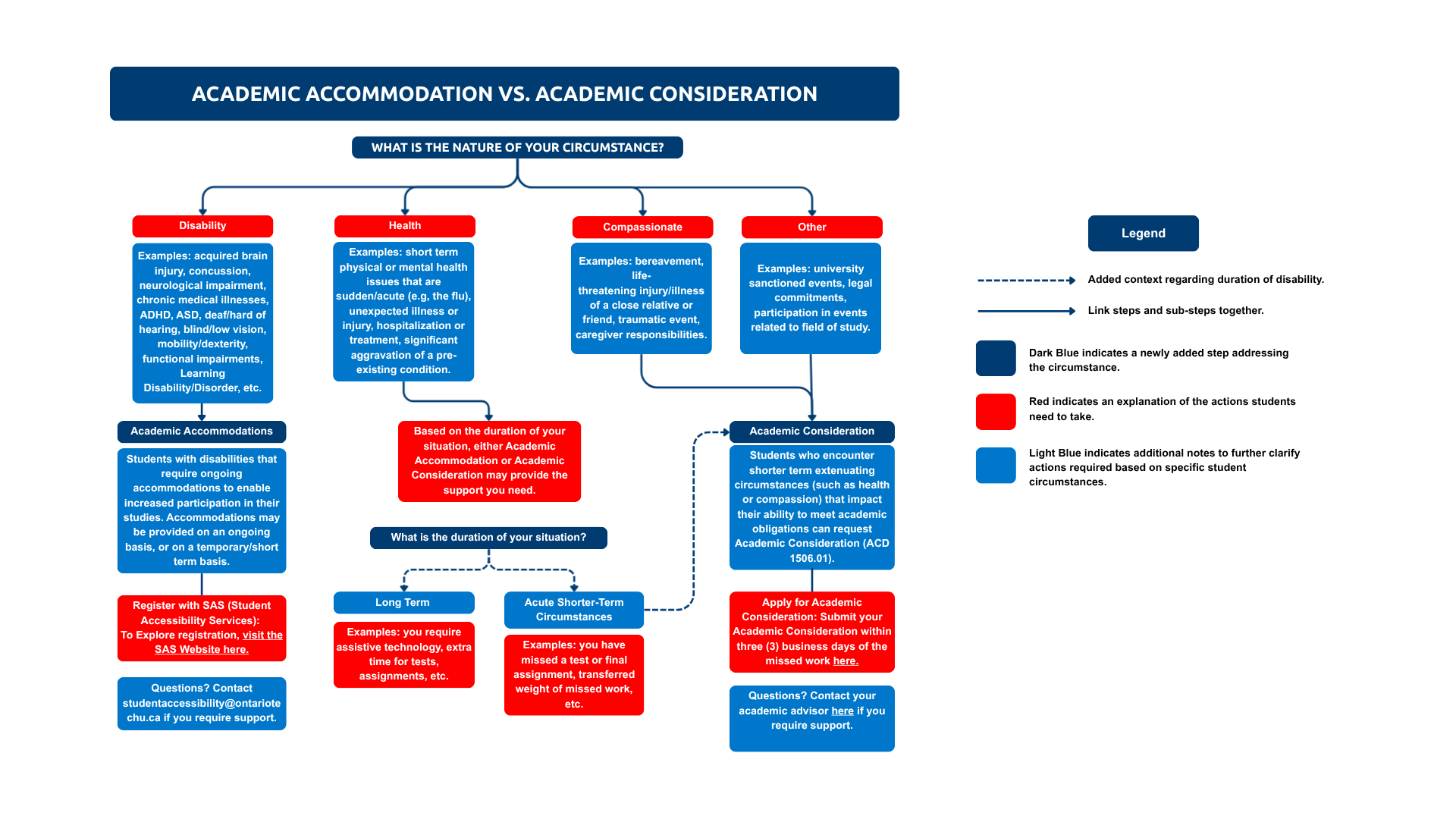
Accommodation vs. academic consideration
Students seeking support with their academic responsibilities due to extenuating circumstances can do so through two avenues: SAS or their respective faculty's office.
The nature of the request determines the appropriate route.
-
Academic accommodations are available to students with visible and non-visible disabilities to remove barriers to learning. Accommodations are specific to each individual and are developed in collaboration with Student Accessibility Services based on supporting medical documentation. Examples include ADHD, ASD, learning disabilities, chronic medical conditions, ongoing mental health challenges, Deaf or hard of hearing status, low vision or blindness, and physical impairments.
-
Academic consideration is a process that provides a compassionate response to students facing short-term extenuating circumstances that impact their ability to meet academic requirements. Academic consideration requests are reviewed and granted by the student’s Faculty Office. Students must follow the procedures and timelines outlined in the University’s Procedures for Consideration of Missed In-Term Course Work and Examinations. Examples that may warrant academic consideration include short-term unexpected/acute health issues, hospitalization, traumatic events, religious observances, and legal commitments.
-
-
Consideration for missed work
Requests for consideration for missed coursework should be submitted as soon as the student is well enough to return to their academic endeavours. Requests for consideration for missed work are to be considered on a case-by-case basis and require faculty discretion.
Students can request consideration for missed coursework in several ways, depending on which option is most appropriate to their situation.
Students can complete a request for deferral of missed coursework or examinations or refer to the university’s procedure for academic appeals. For additional information, review the procedures for consideration of missed in-course work and examinations. -
Consideration for extensions on assignments
SAS recognizes that some students with disabilities may occasionally require additional time to complete assignments due to the impact of their condition. Consideration for extensions on assignments may support students who experience challenges or impairments that affect their ability to meet standard deadlines.
Please note: Extensions are not automatically applied. Extensions on assignments must be negotiated with faculty in advance of the due date. Extensions are considered on a case-by-case basis through the faculty member of the course, in consultation with SAS, to ensure that academic standards are maintained while meeting individual needs.
The duration of the extension is determined by the faculty member at their discretion.
-
Consideration for alternatives to oral presentations
Alternatives to oral presentations may be required for students with documented disabilities that prohibit them from delivering a presentation using traditional methods. Alternatives are discussed with the course faculty member and student. If presentation skills are a core competency or essential requirement of the course, all students are expected to complete the original assessment format. Where approved as a consideration, appropriate alternatives will be considered collaboratively with the student and the instructor.
Requests will be reviewed on a case-by-case basis, based on faculty discretion whilst considering the course learning outcomes. In these cases, faculty members are encouraged to collaborate with the SAS Specialist and the student to find an option that satisfies the learning objectives of the course.
Service animals
Students planning to bring a service animal to campus should register with SAS before attending classes whenever possible.
Registration must occur for the following reasons:
-
Accessibility for Ontarians with Disabilities Act, 2005 (AODA) supports people with disabilities entering public spaces with their service animal. The AODA states that a person can be asked for written confirmation if it is not readily apparent that their animal is a service animal.
-
Ontario Tech campuses are largely non-public spaces. Students enter these educational and training spaces only with approval. Registering with SAS gives students the identification necessary to confirm their animal is a service animal when asked by an appropriate authority.
Registering with SAS to request to bring a service animal to campus involves:
-
Reviewing the University's Procedure for the Use of Service Animals on Campus.
-
Reviewing SAS documentation requirements and submitting the correct documents for your intake appointment.
-
Completing an intake appointment with an Accessibility and Accommodation Specialist.
Remote access requests
Students with disabilities taking courses that are fully in-person, or include in-person components, must fulfill these in-person requirements like all other students. The mode of delivery for an individual course is determined by the program’s intended learning outcomes and expectations established by the faculty. Students must complete all requirements outlined in the course syllabus, including components requiring in-person attendance on the campus offering the course.
Some examples of essential academic requirements that can only be fulfilled on campus are:
-
A dynamic learning process of being observed, receiving feedback and making changes in the moment.
-
Hands-on learning where safety is involved.
-
Learning how to work with people, animals or instruments.
-
Use of specialized lab tools, machines or equipment.
SAS carefully explores remote access requests by thoroughly assessing the student's medical evidence presented, course learning outcomes, and program requirements. SAS will also consult with the student's health-care providers (with written consent), instructors, academic advisors and others as needed.
Certain academic standards and learning objectives may not be feasible in an online-only format. In such cases, alternative solutions will be explored.